Las Fallas in Valencia: What You Really Need to Know Before You Go
If there is one event you should experience in Valencia at least once, it is Las Fallas.
Photos and videos give you an idea of what it looks like, but they don’t really explain what happens to Valencia during Fallas. For several days, the whole city changes. Streets close, enormous colourful sculptures appear between apartment buildings, marching bands seem to come from everywhere, firecrackers start early in the morning and the smell of gunpowder becomes part of the city.
It is loud, crowded, chaotic and sometimes exhausting.
But that’s exactly why Fallas is so special.
If you’re visiting Valencia for the first time during Fallas, there are a few things we would definitely recommend doing.
First: Get a Fallas Map on Your Phone
Don’t try to find the best Fallas simply by walking randomly around the city.
There are hundreds of monuments spread across Valencia, and some of the most impressive ones aren’t necessarily next to the main tourist attractions.
Before you start exploring, get the current official Fallas map/programme on your phone. Tourist information points also provide access to the Fallas map and programme by QR code.
Use it to see where the monuments are located and plan a walking route between them.
Once the Fallas are fully installed, usually from March 16, this becomes one of the best ways to explore the festival.
Our advice: don’t try to see every Falla. You won’t.
Choose several of the major Sección Especial monuments and then simply enjoy discovering smaller ones while walking between them.
And wear comfortable shoes. During Fallas, walking is often much easier than trying to cross the city by car.
Don’t Just Look at the Fallas — Experience a Despertà
This is something many first-time visitors don’t even know exists.
A Despertà happens in the morning when falleros walk through the streets throwing firecrackers to wake up the neighbourhood.
And yes — they really mean wake up.
It’s loud, very Valencian and probably unlike anything you’ve experienced on a normal city break.
You don’t necessarily need to attend every traditional event during Fallas, but seeing a Despertà at least once gives you a much better idea of what this festival is actually about.
Fallas isn’t simply an exhibition of sculptures.
The noise, music, neighbourhood associations and traditions are just as important as the monuments themselves.
You Have to Experience a Mascletà
This is probably the biggest mistake some visitors make.
They hear the word “fireworks” and think they have already seen something similar.
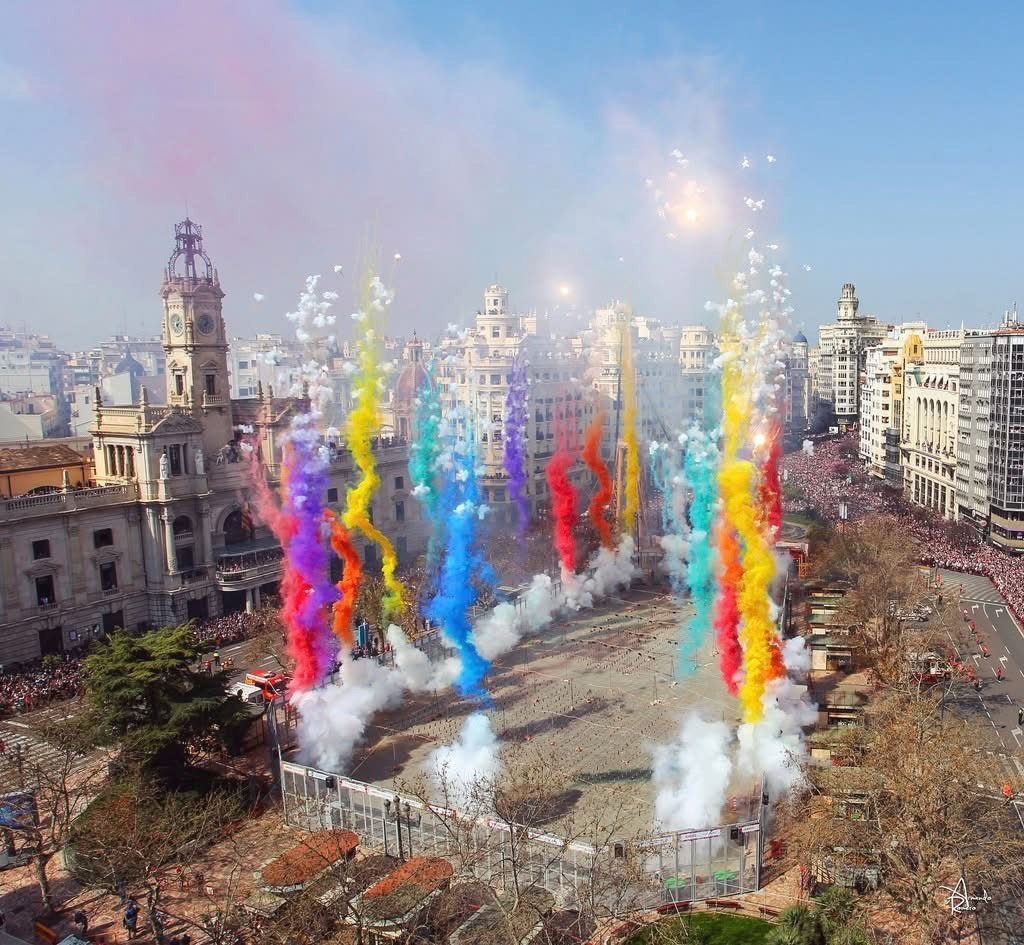
A Mascletà isn’t really about what you see. It’s about what you feel.
Every day from March 1 to March 19 at 14:00, the main Mascletà takes place in Plaza del Ayuntamiento.
The explosions gradually become faster and more powerful until you can literally feel the ground and the air vibrating around you.
For a first visit, try to experience the Ayuntamiento Mascletà at least once.
Arrive Early
Don’t arrive at 13:55 expecting to walk into Plaza del Ayuntamiento.
On the busiest Fallas days, people start gathering long before the show begins; official visitor guidance notes crowds forming an hour or more beforehand.
If you want a genuinely good position, we would arrive around 1½–2 hours early, particularly between March 15 and 19.
Yes, it’s a long wait.
But experiencing your first Mascletà from close enough to actually feel its power is completely different from hearing it several streets away.
See the Fallas During the Day — and Again at Night
This is something we strongly recommend.
During daylight you can properly see the details, colours and satire built into the monuments.
At night the atmosphere changes completely.
The streets are full, neighbourhoods are celebrating, lights are everywhere and Valencia feels like one enormous outdoor festival.
So don’t think: I’ve already seen that Falla.
Walk past some of your favourites again after dark.
They can feel completely different.
Don’t Miss the Night Fireworks
Save some energy for the night.
During the main Fallas days Valencia hosts major nighttime pyrotechnic displays, culminating in the famous Nit del Foc.
This is another event where arriving early makes a big difference.
Thousands of people move toward the viewing areas, so don’t plan to turn up a few minutes before the fireworks begin and expect a perfect position.
Check the current year’s official programme before going because locations and exact schedules can change.
Walk Through Ruzafa at Night
If you want to experience the more intense side of Fallas atmosphere, spend an evening walking around Ruzafa (Russafa).
This isn’t necessarily about ticking another monument off your list.
It’s about the streets.
Lights, music, food, people outside, neighbourhood Fallas and constant movement make this one of the areas where you really feel that Valencia is celebrating.
Just expect crowds.
A lot of them.
Watch the Ofrenda
Among all the explosions and parties, the Ofrenda de Flores shows a completely different side of Fallas.
Thousands of falleros and falleras in traditional Valencian dress make their way through the city carrying flowers to the Virgen de los Desamparados.
If you’ve only seen Mascletàs and fireworks, it’s worth watching part of the Ofrenda because it helps you understand that Fallas isn’t simply a huge street party.
For many Valencians it has a much deeper cultural and family meaning.
And Finally: You Have to See a Cremà
If you’re in Valencia on March 19, don’t leave before the Cremà.
After spending days admiring these enormous works of art, Valencia burns them.
Almost all of them.
That’s the point.
The children’s Fallas burn first, followed later by the large monuments. The exact programme should always be checked for the current year.
Watching a huge Falla disappear into flames while firefighters spray the surrounding buildings is one of those moments that photographs don’t really reproduce.
Here’s the important part: arrive very early.
If you’ve chosen a popular Falla and want to see the Cremà from relatively close, we recommend getting there up to two hours beforehand.
Don’t assume you’ll arrive shortly before it burns and simply walk to the front.
You probably won’t.
The streets around popular Fallas become packed and access can be restricted.
Choose the Falla you want to see burn beforehand, check its scheduled Cremà time, find your viewing position and stay there.
It’s worth the wait.
A Few Things We Wish Every First-Time Visitor Knew
Fallas isn’t the best time to follow a perfectly organised sightseeing schedule.
Streets suddenly become difficult to cross. Buses are diverted. Restaurants fill up. A five-minute walk on Google Maps can become twenty minutes because a Falla, parade or crowd is blocking your route.
So don’t fight it.
Walk.
Explore.
Follow the sound of a marching band occasionally.
Stop when you find a Falla you weren’t planning to see.
And don’t schedule every hour of your day.
During Fallas, some of the best moments are the ones you didn’t plan.
If You Only Have One Day at Fallas
Then we’d keep it simple.
Start in the morning exploring several major Fallas, experience the 14:00 Mascletà, have lunch away from the biggest crowds, continue exploring monuments during the afternoon and watch some of the celebrations after dark.
If there’s a major fireworks display that night, stay for it.
And if your one day happens to be March 19?
Stay for the Cremà.
Even if it means going to bed very late.
Our Final Advice
Don’t visit Fallas expecting a normal Valencia city break.
For a few days, Valencia doesn’t operate normally.
That’s the whole point.
Download the current Fallas map and programme, put on comfortable shoes, expect crowds, experience a Mascletà, see the monuments both during the day and at night, watch the fireworks and, if you possibly can, stay until March 19 to see a Cremà.
You might finish the festival tired, with your ears still ringing and having walked far more kilometres than expected.
But you’ll understand why Valencians spend an entire year preparing to do it all again.
Recent Posts

Best Paella in Valencia: Where to Eat Like a Local

20 Things to Know Before Visiting Valencia