
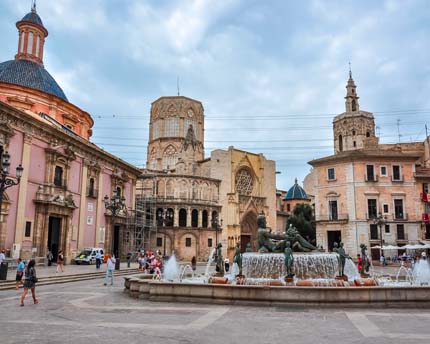
20 Things to Know Before Visiting Valencia
Valencia is an easy city to fall in love with, but your first visit becomes much better once you understand how the city actually works.
Some things aren’t obvious before you arrive. Lunch happens later than you might expect. A restaurant packed with locals can be a much better discovery than the beautiful place next door. The beach is part of Valencia, but that doesn’t necessarily mean you should stay there. And during the hottest weeks of summer, trying to walk around the city at 2pm isn’t always a great idea.
These aren’t rules.
They’re simply things we think are useful to know before your first trip – based on living in Valencia, exploring the city ourselves and seeing the questions visitors ask again and again.
Here are 20 things we would tell a friend before their first visit to Valencia.
1. For a First Visit, Staying in the City Usually Makes More Sense Than Staying at the Beach
This is one of the first decisions many visitors struggle with:
City centre or beach?
If you’re coming primarily for a beach holiday, staying near the sea obviously makes sense.
But if Valencia itself is the reason for your trip – particularly if you only have two, three or four days – we’d usually choose the city.
Ciutat Vella puts you close to the historic sights. Ruzafa gives you restaurants, cafés and nightlife. Cánovas and Gran Vía offer a slightly more polished residential atmosphere while still being very central.
And the beach isn’t difficult to reach from any of them.
We’ve asked visitors in our own Valencia community about this too, and the preference has been clearly towards staying centrally rather than beside the beach.
Think of Valencia as a city with a beach, rather than a beach resort with a city attached to it.
You can spend the morning exploring Mercado Central and La Lonja, have lunch in the city, relax for a while and head towards the Mediterranean later.
If you’re unsure which neighbourhood suits you, read our Where to Stay in Valencia guide.
2. July and August Can Be Seriously Hot
Valencia has a wonderful Mediterranean climate.
But don’t confuse “wonderful climate” with “it’s comfortable to walk around all day in August.”
During the hottest part of summer, temperatures can become uncomfortable, particularly in direct sun.
And the temperature shown by your weather app doesn’t tell the whole story. Walking across an exposed plaza at 14:30 feels very different from sitting under a tree with a cold drink.
Change your schedule instead of fighting the weather.
During very hot periods, we’d plan the day roughly like this:
Morning: sightseeing and walking.
Lunch / early afternoon: eat, rest, find shade, visit somewhere indoors.
Late afternoon and evening: explore again.
You’ll notice that local life naturally adapts to the climate.
There is no prize for crossing Valencia on foot under the midday sun.
Carry water, use sunscreen and find shade before you desperately need it.
3. Don’t Judge a Restaurant by How Beautiful It Looks
One of our favourite ways of choosing somewhere to eat in Spain requires no app at all.
Look inside.
Imagine two restaurants next door to each other at lunchtime.
One has beautiful furniture, perfect Instagram lighting and an employee outside trying to convince tourists to come in.
The other looks ordinary and is packed with Spanish families, workers and groups of friends.
We’d investigate the second one first.
It doesn’t guarantee an amazing meal, of course, but a restaurant consistently busy with local customers during Spanish lunchtime is usually a very encouraging sign.
Some of the most enjoyable meals you’ll have in Valencia may happen in places that don’t photograph particularly well.
Look for a menú del día
At lunchtime, many restaurants offer a set menu – typically courses with several choices and often a drink or dessert depending on the restaurant.
It can be one of the best-value ways to eat in Valencia.
So don’t spend your entire trip searching for restaurants with the highest social-media profile.
Sometimes the best recommendation is simply:
Follow the locals.
4. Paella Isn’t Just Another Spanish Dish Here
Valencia is the birthplace of paella.
That means there are a few things worth understanding before ordering one.
First, Paella Valenciana traditionally isn’t seafood paella.
Traditional Valencian paella normally includes ingredients such as chicken, rabbit, green beans and garrofó beans, although recipes and seasonal ingredients can vary.
You’ll find plenty of seafood rice dishes in Valencia too – and some are fantastic – but don’t assume that seafood automatically means “authentic Paella Valenciana.”
Secondly, paella is traditionally associated much more strongly with lunch than with a late-night dinner.
And thirdly, a good paella takes time.
At restaurants specialising in rice, don’t be surprised if you’re asked to order in advance or wait while it is prepared.
Our advice is simple:
Don’t make your Valencia paella experience an afterthought.
Choose somewhere good, reserve if necessary and make lunch out of it.
5. Spanish Meal Times May Be Later Than Yours
This catches many first-time visitors.
If you normally eat lunch at 12:00 and dinner at 18:00, Valencia can initially feel out of sync.
Lunch often starts later and can continue well into the afternoon.
Dinner also starts significantly later than in northern Europe.
This explains something visitors sometimes misunderstand:
“Why is this supposedly popular restaurant completely empty?”
Because it’s 18:30.
You may simply be two hours ahead of everybody else.
Tourist-oriented restaurants obviously serve food across broader hours, but if you want to experience the atmosphere of a busy local restaurant, adapt your timing slightly.
There’s no need to completely change your habits.
Just understand that Valencia’s clock may be different from yours.
6. Book the Restaurants You Really Care About
Valencia has thousands of places to eat, so you can almost always find something.
But that’s different from getting a table at the restaurant you specifically wanted.
Popular rice restaurants, well-known terraces and fashionable restaurants can fill up, particularly at weekends.
For paella, booking can be even more important because some restaurants prepare rice dishes based on reservations.
Our approach:
If it’s simply lunch while exploring – be spontaneous.
If it’s somewhere you’ve been dreaming about for weeks – reserve it.
There’s nothing worse than travelling hundreds of kilometres to try a particular restaurant and discovering the only available table is three days after your flight home.
7. Valencia Is a Fantastic Walking City – Don’t Spend Your Entire Trip Underground
Metrovalencia is extremely useful.
But once you’re in the historic centre, your feet are often the best transport system.
Mercado Central, La Lonja, Plaza Redonda, the Cathedral, Plaza de la Virgen, San Nicolás, El Carmen and Torres de Serranos can all form part of one excellent walking route.
And the streets between the attractions matter too.
If you constantly travel from pin to pin using Google Maps and public transport, you’ll miss little plazas, façades, cafés and streets that make the Old Town interesting.
Wear comfortable shoes.
Then walk.
8. But Don’t Assume Everything in Valencia Is Within a Ten-Minute Walk
This is the opposite mistake.
Valencia’s centre is compact.
Valencia as a whole isn’t tiny.
The City of Arts and Sciences, beach, historic centre and other areas are spread across the city.
You can walk enormous distances, but that doesn’t mean you should spend half your holiday doing it.
The beach in particular looks deceptively close when looking at a city map.
Use a combination of:
walking + metro/tram + bus + taxi + bicycle.
Save your legs for exploring somewhere interesting rather than proving you can walk 25 kilometres in a day.
9. The Turia Gardens Aren’t Just a Park – Use Them to Move Around the City
One of the best things about Valencia is the Jardín del Turia.
The former riverbed has been transformed into a green corridor running for around nine kilometres through the city. Official tourism information describes it as one of Spain’s largest urban parks.
But tourists sometimes treat Turia as another attraction:
“We need to visit the park.”
Locals use it differently.
It’s somewhere to run, cycle, walk the dog, exercise, meet friends, relax – and move through Valencia.
You can walk or cycle through greenery rather than beside traffic, passing sports facilities, bridges, Gulliver Park and eventually reaching the City of Arts and Sciences.
So don’t simply “visit Turia.”
Use it.
10. Rent a Bike at Least Once
If you’re comfortable cycling, Valencia is one of those cities where a bicycle genuinely makes sense.
The city has an extensive cycling network, and the flat terrain makes cycling considerably easier than in many European cities.
One of our favourite simple routes for a first-time visitor is through the Turia Gardens towards the City of Arts and Sciences.
You see much more than you would underground and cover considerably more distance than walking.
You can also continue towards the maritime neighbourhoods and beach.
Just remember that you’re still part of the traffic system.
Use cycle lanes where appropriate, respect pedestrians and don’t assume every pavement is yours because you’re on holiday.
11. Getting from Valencia Airport to the Centre Is Easy
This is something you really don’t need to worry about before arriving.
Valencia Airport is connected directly to the city by Metrovalencia Lines 3 and 5, and there is an official taxi rank outside the terminal. Aena also lists the metropolitan bus connection.
For one or two people staying near a convenient metro station, we’d normally look at the metro first.
If you’re travelling with several people, young children or lots of luggage, compare the convenience of a taxi.
And if your flight arrives after metro operating hours, the decision becomes even easier.
Our advice: don’t pay somebody to solve a problem you don’t have.
For a straightforward Airport → Valencia city-centre journey, public transport and the airport taxi rank already give you good options.
We’ve explained the choices in detail in our Valencia Airport to City Centre guide.
12. Valencia’s Public Transport Tickets Look More Complicated Than the Transport Itself
Metro.
Bus.
Tram.
SUMA.
Zones.
Airport +.
TuiN.
The terminology can make the system look intimidating when you’re standing in front of a ticket machine for the first time.
Don’t panic.
For most short-stay tourists, the journeys themselves are easy once you’ve worked out which ticket suits your plans.
And don’t buy the most expensive unlimited option automatically just because it sounds convenient.
Think first:
How many journeys will I actually make?
If you’re staying centrally and walking extensively, perhaps fewer than you imagine.
For current fares and ticket conditions, always check the official transport information because prices and temporary discounts can change.
13. Sundays Need a Little More Planning
Sunday in Valencia can be lovely.
Long lunch. Turia. Beach. Old Town. Albufera.
But don’t assume every shop and business operates exactly as it does on Saturday.
Spain has rules governing Sunday and public-holiday retail opening, with designated opening dates and exceptions, so opening patterns can vary by business and time of year.
If shopping is an important part of your trip, don’t automatically save all of it for Sunday.
The same principle applies to museums, markets and individual attractions:
Check opening hours before building an entire day around one place.
Mercado Central is another obvious example – it’s primarily a working market, so don’t treat it as an attraction you can wander into at any hour of any day.
14. You Don’t Need Fluent Spanish – But Five Words Help
Valencia is accustomed to international visitors, and in tourist areas you’ll frequently find people who speak English.
But don’t make that an expectation everywhere.
A few Spanish words go a long way:
Hola – Hello
Por favor – Please
Gracias – Thank you
Una mesa para dos, por favor – A table for two, please
La cuenta, por favor – The bill, please
Nobody expects a tourist to become fluent before a weekend trip.
It’s simply nicer to begin an interaction with Hola rather than immediately launching into English.
And remember that Valencia also has its own co-official language, Valencian, which is why you’ll see signs and place names that may look different from Spanish.
15. Don’t Try to “Complete” Valencia
This is particularly important if you only have two or three days.
We’ve seen itineraries trying to combine:
Old Town.
City of Arts and Sciences.
Oceanogràfic.
Beach.
Albufera.
Museums.
Shopping.
Paella.
Nightlife.
…in what appears to be approximately seventeen minutes.
😄
You can see a lot in Valencia.
But seeing something and experiencing it aren’t the same thing.
If you have three days, give different parts of the city some space.
Spend a proper morning in the Old Town.
Cycle through Turia.
Sit down for a long lunch.
Spend an afternoon near the sea.
Watch the light change over the City of Arts and Sciences.
If you need help deciding what deserves your limited time, use our 3 Days in Valencia itinerary and 30 Must-See Places in Valencia guide.
16. If You’re Coming During Fallas, You’re Visiting a Different Valencia
This deserves its own warning.
Fallas isn’t simply a festival happening somewhere in the city while normal life continues around it.
Fallas takes over Valencia.
The main celebration takes place in March, with hundreds of monuments, fireworks, street events, music, crowds, road closures and the daily Mascletà in Plaza del Ayuntamiento forming part of the experience. The official Fallas programme changes each year.
If you’re coming during Fallas, prepare for:
noise, crowds, fireworks, walking, changed traffic patterns and very late nights.
And that’s part of the attraction.
Don’t book Valencia during Fallas expecting a quiet conventional city break and then become surprised that Valencia isn’t behaving quietly.
Plan specifically for Fallas.
We’ve created a separate Fallas Guide for exactly that reason.
17. Look Beyond the Famous Attractions
Of course you should see the Cathedral.
Of course you should see the City of Arts and Sciences.
But keep looking while walking between them.
Valencia is full of small details that don’t appear on everyone’s itinerary.
A perfect example is La Estrecha in Plaza Lope de Vega, near Plaza Redonda.
Its famously narrow façade is only around 107 centimetres wide. It’s the kind of curiosity you could walk past without noticing if nobody told you to look.
You don’t need to cross the city specifically to photograph it.
That’s exactly the point.
Find it while exploring the surrounding streets.
Our 30 Must-See Places in Valencia guide includes famous attractions, but we’ve deliberately included gardens, streets and smaller discoveries too.
18. Respect the Mediterranean Sun
This sounds obvious until you’re halfway through your first afternoon in August.
Sun exposure builds up while you’re walking.
You may not notice how much you’ve had until later.
In summer, carry water, use proper sun protection and take advantage of shade.
This becomes particularly important at the beach, City of Arts and Sciences and large open plazas where you can spend significant periods in direct sun.
If Spain’s meteorological agency issues heat warnings during your stay, take them seriously and adjust your plans accordingly.
The Cathedral will still be there at 18:00.
You don’t have to see it at 14:00.
19. Valencia Is Enjoyable and Welcoming – But Use Normal City Awareness
There’s no reason to spend your holiday worrying.
But you’re still visiting a major European city.
In busy tourist areas, public transport, crowded events and nightlife areas, keep normal awareness of your belongings.
Don’t leave your phone sitting unattended on the edge of an outdoor café table.
Don’t carry an open bag behind you through a crowded tourist area.
Keep passports and large amounts of cash somewhere sensible.
It’s not about being paranoid.
It’s simply the same common sense we’d recommend in Barcelona, Rome, Paris, London or any other busy city.
20. Leave Some Space for Valencia to Surprise You
This might be our most important recommendation.
Don’t schedule every hour.
Leave an afternoon without a reservation.
Walk into a street because it looks interesting.
Stop at a café because it’s full of locals.
Sit in Plaza de la Virgen longer than you planned.
Take a bicycle through Turia without worrying about reaching the next attraction exactly on time.
Stay at the beach for sunset because you’re enjoying yourself.
Valencia rewards curiosity.
Some of the places you’ll remember most probably won’t be the places you saved on Google Maps before arriving.
One Last Tip From Us
Valencia isn’t a city you need to conquer.
Eat when the restaurants fill up.
Rest when the afternoon becomes too hot.
Walk through the Old Town without checking your phone every two minutes.
Take a bicycle through the Turia.
Try a proper Valencian lunch.
Spend an evening sitting outside with nowhere urgent to go next.
And don’t worry if you don’t see everything.
You’ll probably leave Valencia having visited slightly fewer attractions.
But you’ll have experienced much more of the city.
And that’s usually the better trip.
Continue Planning Your Valencia Trip
From čia straipsnio apačioje aš dėčiau tik 4 vidines nuorodas, kad nebūtų chaoso:
→ 30 Must-See Places in Valencia
→ 3 Days in Valencia
→ Where to Stay in Valencia
→ Valencia Airport to City Centre
One thought on “20 Things to Know Before Visiting Valencia”
Add a Comment Cancel reply
Recent Posts
Best Paella in Valencia: Where to Eat Like a Local
20 Things to Know Before Visiting Valencia
Very interesting for our trip next week. So eager to visit Valencia for the first time