Moros y Cristianos Valencia 2026: A Parade You Shouldn’t Miss
If you’re visiting Valencia on 9 October, don’t plan an ordinary sightseeing day.
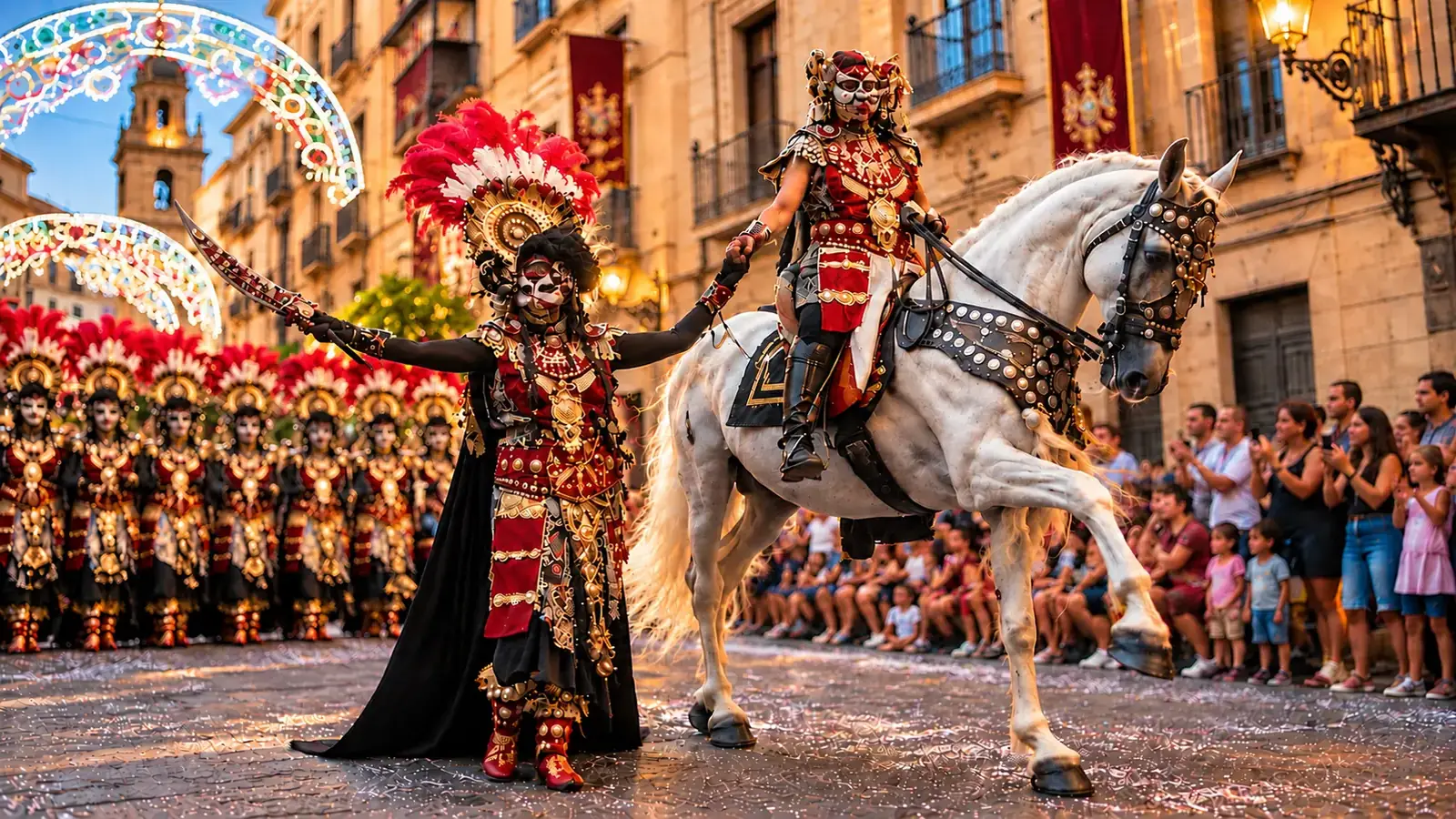
By late afternoon, some of the most elegant streets in the city centre will be filled with marching bands, drums, horses, armour, spectacular costumes and hundreds of participants representing the Moorish and Christian sides of one of Valencia’s most visually impressive traditions.
This is the Entrada de Moros y Cristianos.
And even if you’ve never heard of it before arriving in Spain, it can easily become one of the most memorable things you see during your trip.
The main parade takes place on Friday, 9 October 2026 at 17:00, right through central Valencia.
Our advice: don’t arrive at 17:00.
If you want a good view – especially for photos – choose where you want to watch and get there well before the parade reaches you.
What Is Moros y Cristianos?
To understand the festival, we need to go back centuries.
Large parts of the Iberian Peninsula were under Muslim rule for hundreds of years, while Christian kingdoms gradually expanded southwards.
Valencia itself came under the rule of Jaume I (James I of Aragon) in 1238. His forces entered Valencia on 9 October 1238, a date that eventually became one of the most important dates in Valencian history.
Today, 9 d’Octubre is the Day of the Valencian Community.
The Moros y Cristianos celebrations are a theatrical festive recreation inspired by this much broader history of Muslim and Christian rule, conflict and conquest on the Iberian Peninsula. Valencia City Hall describes the tradition as a historical recreation whose culmination is the procession of the comparsas and filades through the city centre.
But don’t imagine a quiet historical reenactment.
This is a spectacle.
The Costumes Are Half the Reason to See It
If you’ve never experienced Moros y Cristianos before, the costumes can be astonishing.
We’re not talking about a few people wearing simple medieval clothing.
Expect elaborate armour, enormous capes, feathers, dramatic headdresses, metalwork, swords, shields and richly decorated costumes.
Some groups march with military precision.
Others arrive accompanied by horses and theatrical characters.
And behind them come the bands.
Drums, brass instruments and distinctive marcha mora and marcha cristiana music transform the streets completely.
You don’t need to understand every element of the tradition to enjoy it.
But once you understand the history behind the two sides, the whole parade starts to make much more sense.
Moros and Christians: What Are the Two Sides?
You’ll notice that the parade is divided into different groups rather than everyone wearing the same style.
Broadly, they represent two sides:
The Moorish Side
Usually among the most visually extravagant parts of the parade.
Expect elaborate fabrics, dramatic headwear, flowing costumes, jewellery, darker colours and fantasy-inspired interpretations of Moorish aesthetics.
The Christian Side
Armour, helmets, shields, swords and costumes drawing on medieval Christian imagery are much more common.
Different comparsas and filades have their own identities, costumes and musical accompaniment.
That’s why the parade doesn’t feel repetitive.
Every few minutes, the visual style can change completely.
Why 9 October Matters in Valencia
This is important because Moros y Cristianos isn’t the whole 9 October celebration.
October 9 is Día de la Comunitat Valenciana – the Day of the Valencian Community.
It commemorates Jaume I’s entry into Valencia in 1238.
One of the most important symbols of the day is the Reial Senyera, Valencia’s historic flag.
At midday, it forms the centrepiece of the traditional Civic Procession through Valencia before the procession pays tribute to Jaume I at his monument in the Parterre. The celebration then continues with a mascletà in Plaza del Ayuntamiento.
So if you’re in Valencia that day, don’t think of Moros y Cristianos as an isolated parade.
The whole city is celebrating.
2026 Is an Especially Interesting Year
There’s another reason why this year’s celebration is worth seeing.
2026 marks 750 years since the death of Jaume I.
For this anniversary, Valencia will display the Reial Senyera together with the sword of Jaume I in the Salón de Cristal at City Hall on 8 October.
Both symbols will also form part of the wider commemorations on 9 October.
So if you’re interested in Valencia’s history, this particular year has additional significance.
Moros y Cristianos Valencia 2026: Date & Time
Now for the information you’ll actually need.
Friday, 9 October 2026
15:45 – Bajada de Gloria
This takes place before the main Entrada, travelling in the opposite direction along the parade route.
17:00 – XXI Entrada de Moros y Cristianos Ciudad de Valencia
This is the big one.
If you’re visiting Valencia, this is the parade we’d make sure you see.
Where Does the Parade Go?
The official 2026 route begins at:
Jardines de la Glorieta
and continues through:
Calle de la Paz
↓
Poeta Querol
↓
Calle de las Barcas
↓
Plaza del Ayuntamiento
↓
Avenida Marqués de Sotelo
↓
before finishing around the junction with Calle Xàtiva, opposite Estación del Norte and Plaza de Toros.
This is good news for visitors.
You don’t have to travel outside Valencia or find an obscure neighbourhood.
The parade runs straight through the heart of the city.
Where Should You Watch the Parade?
There isn’t one perfect position for everybody.
We’d choose according to what you want.
📸 Our Pick for Photos: Calle de la Paz
This would probably be our first choice if photography is important.
It’s one of Valencia’s most beautiful central streets, and the architecture creates a fantastic background for the costumes, horses and marching groups.
Because the procession comes from Glorieta, you’ll also see participants relatively early in the parade.
🎉 For the Biggest Atmosphere: Plaza del Ayuntamiento
If you want to feel that you’re in the middle of a major city celebration, choose the area around Plaza del Ayuntamiento.
The setting is spectacular and you’re right in the heart of Valencia.
The trade-off?
Expect crowds.
🚉 Another Option: Marqués de Sotelo
The final stretch towards Estación del Norte is another option worth considering.
The wide avenue gives the procession a completely different visual backdrop from the narrower streets earlier in the route.
⚠️ Don’t Arrive at 17:00
This may be the most useful advice in this entire article.
The parade starts at 17:00.
That doesn’t mean you should arrive at your chosen viewing position at 17:00.
If you want to be close to the front and take good photographs, arrive well in advance.
Exactly how crowded each section becomes can vary, so we wouldn’t promise that arriving a particular number of minutes early guarantees a front-row position.
But the principle is simple:
the better the position you want, the earlier you should arrive.
Bring water.
Wear comfortable shoes.
And once you have a really good spot…
think twice before giving it up.
Make a Full Day of 9 October
We wouldn’t come into Valencia only for the 17:00 parade.
There’s enough happening to make a full day of it.
Morning – Explore the Historic Centre
Start around:
Plaza de la Virgen → Cathedral → Plaza de la Reina → Mercado Central → Lonja
But expect parts of the centre to be busier than on a normal day.
12:00 – Procesión Cívica
One of the most important traditions of 9 d’Octubre.
The Reial Senyera leaves City Hall and is carried through Valencia as part of the Civic Procession.
The route includes the Cathedral and continues to the monument to Jaume I at the Parterre before returning to City Hall.
Around 14:00 – Mascletà
Once the Civic Procession has finished, a traditional mascletà is scheduled in Plaza del Ayuntamiento.
If you’ve never experienced one before, don’t expect a conventional fireworks show.
A mascletà is about sound, rhythm and explosive intensity.
You feel it as much as hear it.
Lunch
After the mascletà, eat.
But remember that thousands of other people have roughly the same idea.
This is one day when we’d definitely reserve a restaurant in advance.
Afternoon – Get Into Position
Don’t try squeezing another attraction into the hour before the parade.
Make your way towards Calle de la Paz, Plaza del Ayuntamiento or another part of the official route and find your position.
17:00 – Moros y Cristianos
Then put the phone down occasionally.
Take your photos.
Film the costumes.
But also actually watch it.
The combination of the costumes, marching bands, horses and historic streets is much better in person than it looks on a screen.
The Celebrations Actually Begin Before 9 October
If you’re in Valencia for several days, there’s more.
The official 2026 programme begins on Friday, 2 October at 20:00 with the Entraeta Festera, starting from Plaza de la Virgen and passing through streets of the historic centre before returning to the square.
On Saturday, 3 October at 17:00, there’s an Entrada Infantil de Moros y Cristianos, followed at 20:00 by the Embajadas de la Conquista beside Torres de Serranos.
On Sunday, 4 October, the programme continues with a floral offering at the Cathedral at 11:30 and the traditional Alardo afterwards.
So visitors arriving before October 9 can still see parts of the tradition.
Don’t Miss the Night Before Either
On 8 October, Valencia City Hall’s Salón de Cristal is scheduled to open from 10:00 until 21:00 for La Nostra Senyera, where the Reial Senyera and the sword of Jaume I will be displayed together for the 750th anniversary year.
And later that evening, Valencia celebrates with fireworks.
If your trip allows it, we’d strongly consider being in the city for both 8 and 9 October, rather than arriving only for the parade.
One More Valencia Tradition: Sant Donís
There’s another lovely detail visitors often don’t know.
October 9 is also Sant Donís, traditionally associated with Valencian lovers.
Couples give each other the mocadorà – a scarf containing colourful marzipan sweets shaped like fruits and vegetables, along with traditional piuleta and tronaor sweets. Valencia City Hall lists the tradition as part of the city’s 9 d’Octubre celebrations.
So when you see pastry shops filled with tiny colourful marzipan fruit around this time…
now you know why.
That’s exactly the sort of small detail that makes the festival much more interesting when you’re visiting.
Travel to Valencia Tip
Don’t treat 9 October like a normal sightseeing day.
Road closures, processions and crowds will change how you move through central Valencia.
Instead of fighting against it, make the celebration your itinerary.
Watch the Civic Procession.
Experience the mascletà.
Have a long lunch.
Find a good position.
And finish with Moros y Cristianos.
If you’re lucky enough to be visiting Valencia on this date, you’ve accidentally chosen one of the most interesting days of the year to be here.
Is Moros y Cristianos Worth Seeing?
Absolutely – especially if you’ve never seen one before.
You don’t need to understand every piece of Valencian history before you arrive.
The costumes alone are spectacular.
The music changes the atmosphere completely.
The horses and marching groups make it feel theatrical.
And seeing all of it pass through the historic centre of Valencia gives the event a setting that’s difficult to recreate anywhere else.
But knowing a little of the history beforehand makes it even better.
Because you’re no longer simply watching people in beautiful costumes.
You’re watching a modern Valencian celebration built around centuries of history, identity and tradition.
Planning to Be in Valencia on 9 October?
Save this guide before your trip.
We’ll keep an eye on the official programme and update the article if any timings, routes or arrangements change before the celebration.
And if you’re planning several days in Valencia, continue with:
→ 3 Days in Valencia: The Perfect Itinerary
→ 20 Things to Know Before Visiting Valencia
→ Valencia Nightlife: Where to Go for Drinks, Music & Clubs
Recent Posts
Moros y Cristianos Valencia 2026: A Parade You Shouldn’t Miss
Valencia Nightlife: Where to Go for Drinks, Music & Clubs