Why Are Valencians So Obsessed With Fire?
Spend enough time in Valencia and something strange happens.
At first, every explosion makes you stop.
You look around.
You wonder what just happened.
After a while, you stop asking why something is exploding and start wondering why it has been quiet for so long.
Fireworks at lunchtime.
Firecrackers before breakfast.
Enormous monuments deliberately set on fire in the middle of the city.
People dancing beneath showers of sparks.
Entire streets temporarily filled with smoke, noise and the unmistakable smell of gunpowder.
For visitors, Valencia’s relationship with fire can be surprising.
For Valencians, it is simply part of the culture.
Fire and gunpowder appear in religious celebrations, neighbourhood fiestas, weddings, local festivals and, of course, Fallas.
And some of those traditions involve quantities of gunpowder that would probably cause mild panic almost anywhere else in Europe.
So why does Valencia love fire so much?
Fire Is Everywhere in Valencia
The most obvious example is Las Fallas.
Every March, enormous monuments appear across Valencia.
They can take months to design and build.
Some are huge.
Some are incredibly detailed.
Many cost considerable amounts of money.
For several days, people walk around the city admiring them.
And then, on the night of 19 March, Valencia deliberately burns almost all of them.
This is La Cremà.
And the fire is not an unfortunate ending to Fallas.
It is the point.
Months of work disappear in minutes as flames engulf the monuments, crowds gather around them and firefighters protect the surrounding buildings.
If you’re seeing it for the first time, the obvious question is:
Why build something so beautiful just to destroy it?
That question takes us much closer to understanding Valencia.
Fallas: Building Something Just to Burn It
The traditional story of Fallas connects the festival with Valencia’s carpenters.
Around the feast of Saint Joseph, the patron saint of carpenters, unwanted pieces of wood and old workshop structures were burned.
Over time, figures began to appear in the fires.
Then came humour.
Satire.
Politics.
Characters.
And eventually the simple bonfires evolved into the enormous artistic fallas we see today.
The scale has changed dramatically.
But one thing hasn’t:
everything is still created knowing that it will eventually burn.
That gives Fallas a strange emotional quality.
People can spend an entire year creating something beautiful while knowing exactly how the story ends.
Then the flames rise.
People applaud.
Music plays.
And sometimes there are tears.
The next morning, the streets are cleaned.
The ashes disappear.
And almost immediately, people begin thinking about what they will create next year.
Mascletà: Fireworks You Feel, Not Just Watch
But flames are only half the story.
Valencia also has an extraordinary relationship with gunpowder.
And nowhere is that more obvious than during a mascletà.
During the main Fallas period, thousands of people gather in Plaza del Ayuntamiento at 14:00.
If you’re expecting a normal fireworks display, you may initially be confused.
There often isn’t much to look at.
That’s because a mascletà is not really designed to be watched.
A mascletà is about sound, rhythm and physical sensation.
The explosions build gradually.
The rhythm changes.
The noise becomes heavier.
Then comes the final barrage.
The ground seems to vibrate.
You feel the pressure in your chest.
Smoke hangs between the buildings.
And when it ends, thousands of people start applauding.
This is one of the most important things to understand about Valencian pyrotechnics.
It is not always about beautiful colours in the sky.
Sometimes:
the noise itself is the spectacle.
Yes, Valencia Wakes People Up With Firecrackers
If the mascletà seems unusual, wait until you experience a despertà.
The word itself gives you a clue.
It comes from the idea of waking people up.
And how do you wake up a Valencian neighbourhood during a festival?
Apparently, with firecrackers.
Early in the morning, groups move through the streets setting off loud fireworks and firecrackers.
Yes.
Deliberately waking the neighbourhood with explosions is a tradition.
For visitors staying nearby, the first experience can be memorable for completely different reasons.
But within Fallas culture, the despertà is another example of how sound, gunpowder and celebration are inseparable.
The festival doesn’t quietly begin when you decide to leave your hotel.
Sometimes the festival decides when you wake up.
Nit del Foc: When the Sky Takes Over
Of course, Valencia does traditional fireworks too.
And when it does, it doesn’t exactly hold back.
One of the most famous examples is Nit del Foc — the Night of Fire.
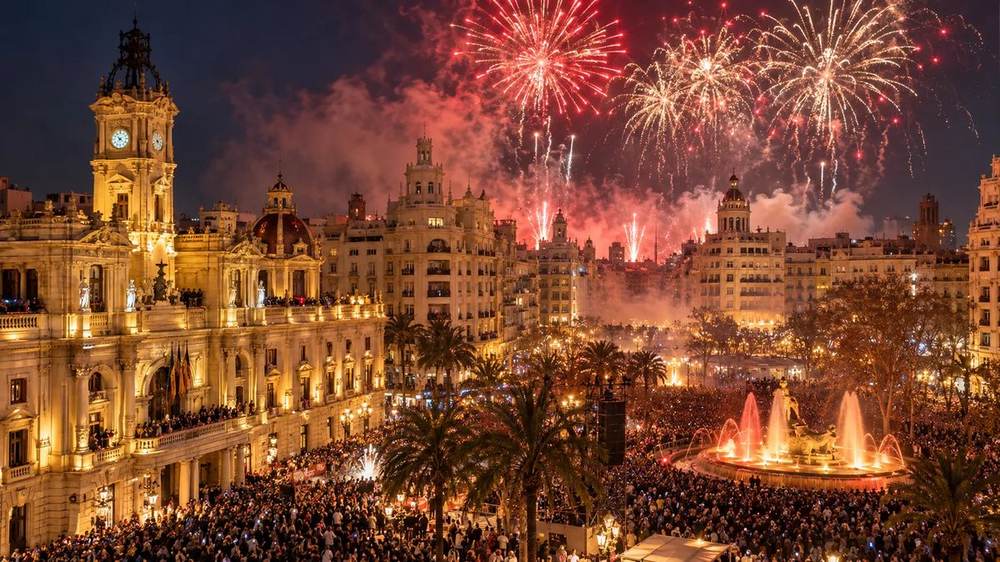
During Fallas, Valencia’s night sky becomes the stage for one of the largest fireworks displays of the celebrations.
This is the more familiar side of pyrotechnics.
Colour.
Height.
Choreography.
Huge explosions above the city.
Similar castillos take place during other celebrations throughout the year.
So Valencia’s relationship with pyrotechnics has both sides:
the fireworks you watch…
and
the fireworks you feel.
The Cordà: When Things Get Serious
Travel a few kilometres outside Valencia city and things can become even more intense.
Every August, Paterna holds its famous Cordà.
This is difficult to understand properly from photographs.
We’ve experienced the Cordà ourselves, and photos really don’t prepare you for what it feels like.
The noise is extraordinary.
So is the heat.
Smoke fills the area.
Rockets and firecrackers appear to be everywhere at once.
Participants wear heavy protective clothing while an enormous quantity of pyrotechnics is fired inside a specially controlled space.
From the outside, it can look completely insane.
From inside the tradition, it makes perfect sense.
This isn’t a fireworks display where spectators stand quietly behind a barrier watching something happen in the distance.
The energy of the gunpowder is the experience.
And when you’re close enough to feel the heat, hear the explosions bouncing around you and smell the smoke, you understand why video never quite captures it.
Correfocs: Dancing Under the Sparks
Then there are correfocs.
These take fire in another direction entirely.
Groups dressed as devils and other characters move through the streets carrying pyrotechnics.
Sparks fly above the crowd.
People dance underneath them.
Music, drums, smoke and fire turn the street into something completely different.
Again, the important thing is proximity.
Fire is not always something happening far away on a stage.
In Valencian celebrations, it can be right in the middle of the crowd.
That may sound intimidating if you have never seen it before.
But it explains something fundamental about local festival culture:
people don’t just watch the celebration.
They become part of it.
Valencia Has a Serious Pyrotechnic Tradition
All of this didn’t appear by accident.
The Valencian Community has a long tradition of professional pyrotechnics.
Firework-making became a specialised local craft, with knowledge and techniques passed through generations.
Pyrotechnic companies from the region now create displays for major celebrations well beyond Valencia.
But their strongest connection remains with the local festivals that helped create the demand for the craft in the first place.
Fallas.
Local fiestas.
Religious celebrations.
Mascletàs.
Castillos.
Cordàs.
All of them created a culture where pyrotechnics became much more than entertainment.
They became part of local identity.
Fire Means More Than Entertainment
There is also something deeper going on.
Fire in Valencian celebrations can represent:
ending and beginning.
destruction and renewal.
celebration and memory.
Fallas demonstrates this perfectly.
An enormous amount of creativity, money and effort goes into building something that everyone already knows will disappear.
Then it burns.
The streets are cleared.
And the process starts again.
That cycle is part of what makes La Cremà unexpectedly emotional.
It isn’t simply:
“Now we burn the statue.”
It is the end of one Fallas year and the beginning of another.
Something disappears.
Something new will replace it.
Why Visitors Find It So Surprising
Many visitors come from places where fireworks are highly restricted or used only for a handful of major events each year.
Valencia feels completely different.
You might hear fireworks during lunch.
During a religious procession.
At a wedding.
During a neighbourhood fiesta.
Before breakfast.
After midnight.
Sometimes you know exactly what is being celebrated.
Sometimes you don’t.
And that’s when visitors begin asking the question:
“What was that explosion?”
Usually, the answer is less dramatic than you might imagine.
Someone is celebrating something.
Eventually, You Stop Asking
After living in Valencia for a while, your reaction begins to change.
At first:
BANG.
“What was that?”
Later:
BANG.
“Probably a fiesta.”
Eventually:
Silence.
“Is something wrong?”
That’s when you know Valencia has started to affect you.
Because the city doesn’t simply enjoy fireworks.
Fire, smoke and gunpowder are part of the language of celebration here.
They announce that something is happening.
They mark important moments.
They bring neighbourhoods together.
And they connect modern Valencia with traditions that have been repeated for generations.
So if you’re new to Valencia and suddenly hear an enormous explosion outside your window…
there is usually no need to panic.
Somewhere nearby, somebody is probably celebrating something.
And if there isn’t a festival today?
Just wait a little while.
There probably will be one tomorrow.
Discover More of Valencia
Want to understand more than just Valencia’s famous landmarks?
Our Valencia Local Guide lets you explore the city at your own pace with mapped stops, prepared audio stories and interactive questions along the way.
Take a photo. Ask a question. Get an answer.
Built around real Valencia.
Recent Posts

Valencia for Cruise Passengers: What to See in 4, 6 or 8 Hours
12 Best Hikes Near Valencia: Canyons, Caves & Mountain Views